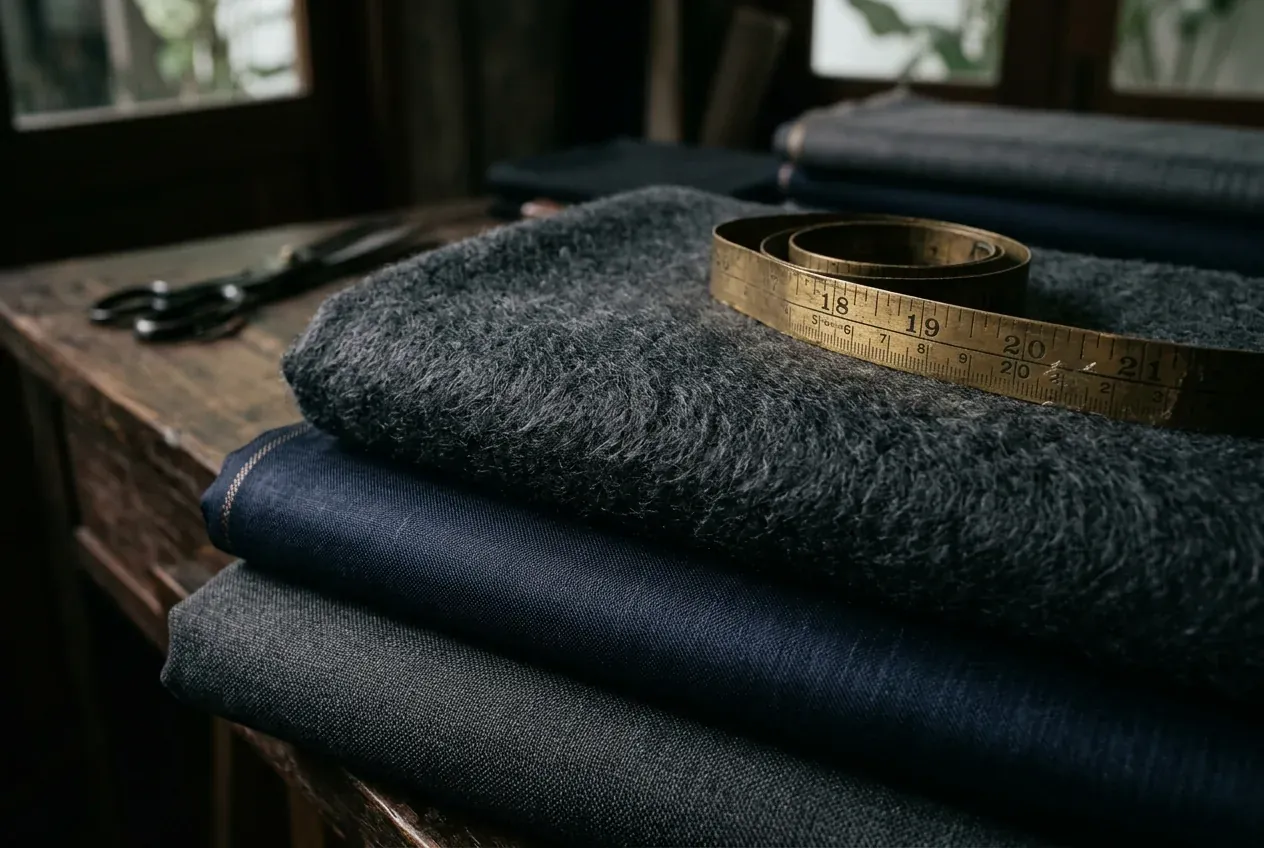
The most breathable suit fabric is an open-weave, high-twist wool in a light weight — fresco or a tropical worsted — ahead of linen, which breathes as well but creases permanently, and well ahead of cotton or any polyester blend. Weave and weight decide comfort more than the fibre name on the label does.
Weight before fibre
Weight is the number to settle first, because it changes how a finished garment feels in heat more than the fibre name does. Most guides start with the fibre; start here instead.
Cloth is sold by grams per metre. A year-round business worsted runs 280 to 340g. For sustained heat you want 200 to 260g, and the difference between a 300g suit and a 240g one is immediately obvious on a warm afternoon in a way that swapping fibres at the same weight is not.
Below about 200g you start paying for it. Very light cloth drapes poorly, shows every seam and pull, and wears through at the trouser seat and inner thigh far sooner. There is a floor, and cloth sold on lightness alone rarely mentions where it is.
Weight first, then weave, then fibre. That order gets you a wearable suit even if you never learn what fresco is.
The cloths, compared
Six cloths cover almost everything you will be offered for a hot climate, and they separate on four things: how much they weigh, whether they breathe, whether they crease, and whether they recover afterwards.
| Cloth | Typical weight | Breathes | Creases | Recovers | Best for |
|---|---|---|---|---|---|
| Linen | 200–260g | Exceptionally | Immediately, permanently | Poorly | Weddings and holidays, where creasing reads as character |
| Tropical wool | 230–260g | Very well | Moderately | Very well | Daily wear in heat; the safe default |
| Fresco / high twist | 240–290g | Exceptionally | Barely | Exceptionally | Long days, travel, sitting down a lot |
| Cotton | 240–300g | Well | Readily | Poorly | Casual jackets and separates |
| Wool-linen blend | 220–260g | Very well | Moderately | Well | Linen’s look without linen’s collapse |
| Polyester blend | any | Badly | Barely | Well | Nothing, in this climate |
Polyester is in the table for one reason: it is what a cheap suit is made of, and it is the only entry here that fails at the actual job. It does not pass moisture, so it holds heat against you regardless of the weight it is sold at.
Weave: fresco, hopsack and high twist
Two cloths at identical weight in the identical fibre can behave completely differently, and the reason is the weave. Hold a length up to a window: if you can see light through it, air can move through it too.
- Fresco is a high-twist wool woven deliberately open and porous. It is the coolest wool you can buy, resists creasing almost completely, and has a dry, slightly rough handle.
- Hopsack is a basketweave, woven in pairs rather than singles. Visibly textured, breathes well, and forgiving on a body that is not symmetrical. It snags more easily than a plain weave.
- High twist describes the yarn rather than the pattern: spun tight so it is springy and holds itself open. Most frescos are high twist, but so are many plain worsteds sold as tropical wool.
- Plain worsted is the standard smooth business cloth. Densest of the four, and the one to avoid here unless the weight is genuinely low.
What each one trades away
Every cloth on that table costs you something, and five of them cost you something worth knowing before you choose. Every guide lists what a cloth gives you; this is the other column.
- Linen creases by construction, not by neglect. The fibre has almost no elasticity, so a crease is a fold that stays folded until it is pressed out. If that will bother you, no amount of quality changes it.
- Fresco is scratchy to some people. The same high twist that makes it cool makes it dry and firm against the skin, and a minority find it unwearable on a bare arm. Handle it before you commit.
- Cotton has poor recovery. It creases like linen but without linen’s reputation for doing so, so it simply looks rumpled. It also bags at the knee and elbow and stays bagged.
- Tropical wool is a compromise on every axis. It is not the coolest, not the most crease-resistant, not the most characterful. It is the one least likely to disappoint.
- Wool-linen blends inherit some of linen’s creasing along with its texture. Less than pure linen, more than the sample card suggests.
The same logic runs a layer down, at the shirt: how a shirt should fit matters as much in heat as the cloth does, because a shirt that grips leaves no air gap to work with.
The lining nobody mentions
The lining is the layer that undoes the cloth you just chose. You can pick correctly and then seal it in. Most jackets are fully lined in polyester or acetate, and that lining sits between the cloth and your shirt across the whole body of the jacket. The outer cloth then breathes into a plastic bag.
Ask for the jacket half-lined, or unlined through the back. It is a small change and it does more for comfort than moving one step down in cloth weight. The same goes for trousers: an unlined trouser in a decent cloth beats a lined one every time in humidity. Construction interacts with all of it, and what canvas construction changes is the other half of how warm a jacket runs. Choosing for the climate is a separate decision from choosing an expensive cloth — what a garment costs here is set by the cloth book you choose and the handwork in the garment, not by whether the weave is open or dense. If you want any of this cut to your own measurements, that is what bespoke suits and jackets for men covers, here in Phuket.