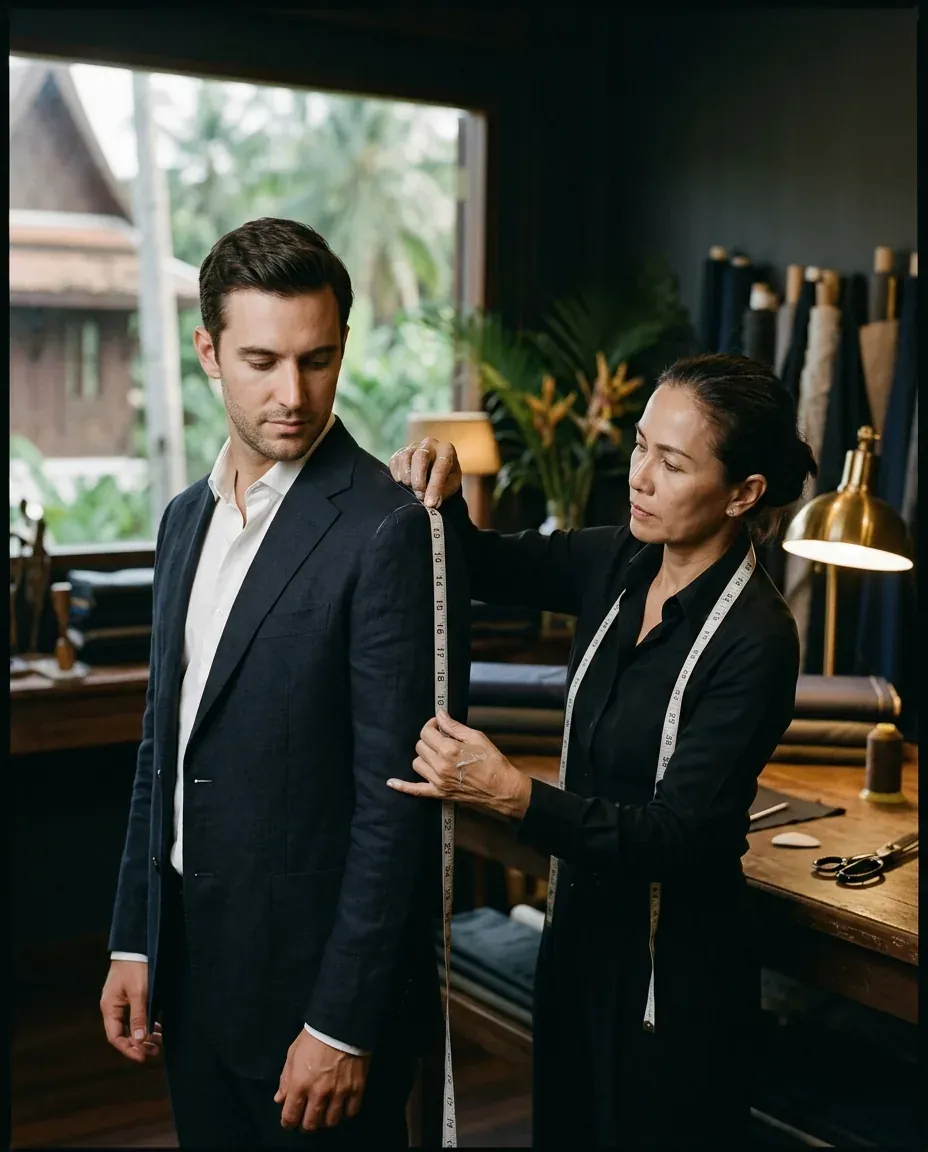
Most pieces are ready in 24 to 48 hours over two to three fittings, and that is the honest published figure rather than a marketing one. What it does not mean is that any garment can be built in a day. The real constraint is not sewing speed but the space between appointments, because a garment has to be worked on between one fitting and the next.
What fits in 24 to 48 hours
The published figure covers most pieces over two to three fittings, and the garments it comfortably covers are the simpler ones: shirts, trousers, an unstructured jacket, a copy of something you already own. Those have fewer structural decisions to get wrong, so a single fitting genuinely resolves them.
A suit fits inside the window too, but the arithmetic is tighter and worth understanding. Two fittings inside 48 hours means the first happens on day one and the second on day two, with the correction made overnight. That works when the correction is small. When the first fitting reveals something structural — a balance problem, a shoulder that needs resetting — the honest answer is that it needs another day, and a shop that promises otherwise is promising to skip the correction rather than to work faster.
So the figure is real, and the thing it depends on is you being available for the fittings rather than the workshop being quick.
What needs longer
A full canvas, a cloth we do not stock, three fittings, and anything for a wedding. Those genuinely cannot be compressed, and it is better to know which before you start.
A fully canvassed jacket is hours of hand work in the front alone, and those hours cannot be moved. Three fittings, where the first is on a deliberately unfinished garment, needs the days to put between them. A cloth that is not in the shop has to be ordered in. Anything for a wedding, where the consequence of a poor fit is not recoverable, should be planned in weeks rather than days. And a first garment with a maker who has never measured you before is worth more time than a repeat order, because the first one is where the pattern is learned.
None of that makes a fast garment bad. It makes fast and complex a pair you have to choose between.
What you give up when it is rushed
The unfinished first fitting, the hand work, the settling time, the second correction, your own judgement, and any slack at all. Every tailor on this island advertises 24 hours; that is what the speed is made of.
- The unfinished first fitting. The most valuable appointment in the process is the one where the garment is deliberately incomplete and the shape is still open. Compress the schedule and it disappears, and the correction has to happen on a finished garment instead — which limits it to what the seams will give.
- Hand work. Canvas is stitched by a person; fusing is glued by a machine in minutes. When a timeline will not accommodate the hours, the construction changes to fit the clock. What canvas construction changes explains what that costs you over the garment’s life.
- The settling time. Cloth relaxes after it is cut and pressed. A garment finished and worn the same hour is being judged before it has settled.
- A second correction. One fitting means one chance. If the first correction slightly overshoots, there is no appointment left to bring it back.
- Your own judgement. Choosing cloth, cut and details in a single visit under time pressure is how people end up with a suit that fits well and that they do not much like.
- Room for anything to go wrong. No slack in the schedule means a delay of any kind lands on your flight rather than on the workshop.
What each appointment is actually for is set out in what happens at each fitting, and it is the clearest way to see which of them a rush removes.
Counting back from your flight
Visitors think in nights remaining, so work backwards rather than forwards.
- Start at your departure date and subtract a full day. Collecting a suit on the morning of a flight leaves nothing for a final adjustment, and it is the commonest planning error.
- Subtract another day for the final fitting. This is the appointment where lengths are confirmed against your actual shoes.
- Subtract at least one working day for the correction between the first fitting and the final one. This is the day that gets deleted when a schedule is compressed, and it is the one that makes the garment fit.
- Subtract a day for the first fitting. This has to be far enough after measuring for the garment to exist in a fittable state.
- What is left is your latest sensible start date. If that date has already passed, the honest options are a simpler garment, fewer pieces, or alterations to something you own rather than something new.
Working it through usually shows a three-night stay can produce an excellent shirt or trouser and a rushed suit, while five nights produces a good suit without hurrying anyone. The full sequence as we run it is in how a fitting works here.
High season
Phuket’s busy months run roughly from November to April, and the practical effect is on appointment availability rather than on how long a garment takes to make. What a garment needs does not change with the calendar; what changes is how easily you can get the second and third appointments on the days you want them.
We do not publish a different high-season turnaround, so the right move is to ask when you enquire rather than to assume either way, and to book the first appointment before you arrive if your dates are tight. Nothing on this page should be read as a guarantee for a specific week — confirm your dates with us and you will get a straight answer for those dates.
If you run out of time
The garment can be finished after you leave and sent on to you, which turns a hard deadline into a soft one and is a much better outcome than collecting something rushed through its last stage. The trade is that you lose the final fitting, so it works best when the earlier fittings went cleanly and the remaining work is finishing rather than shaping.
The other option is to reduce scope rather than quality: one well-made jacket instead of a three-piece suit, or alterations to a suit you already own. Reducing scope changes the figure too, and what a garment costs here is itemised by piece rather than sold as a package, so dropping the waistcoat is a real saving rather than a renegotiation. What shipping actually involves, and how to carry a finished garment without undoing the press, is covered in getting a tailored suit home.