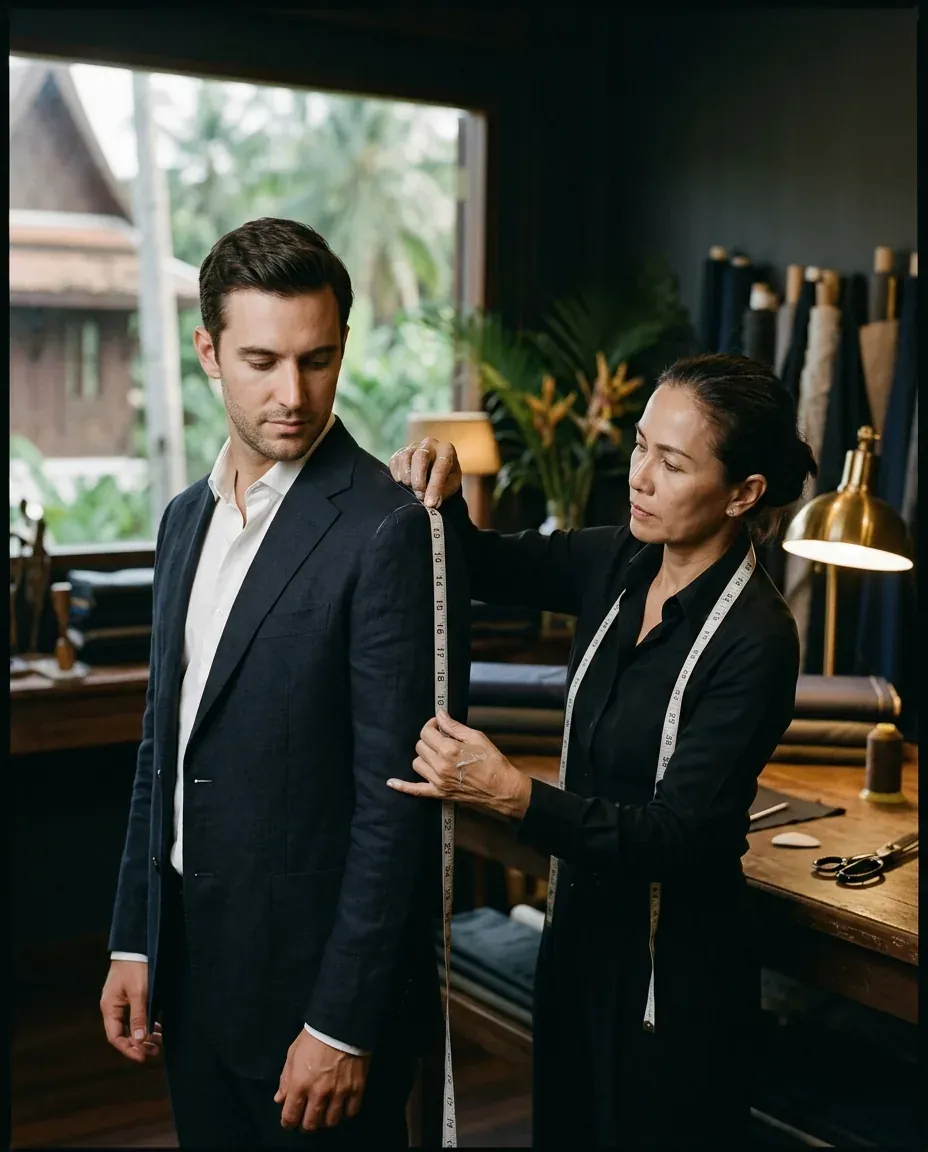
To measure for a suit, take the chest around the fullest point with the tape level and the arms down, the waist at the natural waist rather than the trouser line, the seat around the widest part, the sleeve from shoulder bone to wrist bone with the arm slightly bent, and the trouser inseam from crotch to the top of the shoe. Those five numbers get you a size. They do not get you a fit, and the gap between the two is the rest of this page.
The measurements you can take yourself
Eight, and they are the eight below. Use a soft tape. Wear a thin shirt, not a jacket. Stand as you normally stand, breathe out, and do not pull the tape tight — it should sit against you without compressing. If someone can help, the results will be better.
- Chest. Around the fullest part of the chest, under the arms and across the shoulder blades. Keep the tape level all the way round; the commonest error is letting it ride up at the back.
- Natural waist. Around the narrowest part of the torso, usually an inch or so above the navel. This is not where your trousers sit, and confusing the two is the second commonest error.
- Seat. Around the widest part of the hips and seat, feet together.
- Shoulder. From the bony point of one shoulder straight across the back to the other. This is the one you cannot do alone with any accuracy.
- Sleeve. From the shoulder bone, down the outside of the arm to the wrist bone, with the arm slightly bent rather than locked straight.
- Jacket length. From the base of the collar at the back down to where you want the jacket to end.
- Trouser waist. Where you actually wear your trousers, which is a different number from the natural waist.
- Inseam. From the crotch seam of a well-fitting pair of trousers down to the top of the shoe. Measuring an existing trouser flat on a table is more reliable than measuring your leg.
Take each one twice. If the two readings differ, take a third.
What a suit size actually means
A suit size is the chest measurement in inches, with a letter for the length — and nothing else is measured at all. The trouser waist is then assumed rather than measured, which is where most of the trouble starts.
| Size | Chest | Assumed waist | Length band |
|---|---|---|---|
| 38S | 38 in | 32 in | Short — roughly up to 5’7” |
| 38R | 38 in | 32 in | Regular — roughly 5’8” to 6’0” |
| 38L | 38 in | 32 in | Long — roughly 6’1” and above |
| 42R | 42 in | 36 in | Regular |
| 44R | 44 in | 38 in | Regular |
The gap between chest and waist is called the drop, and off-the-peg suits assume it is six inches. If yours is four, every jacket in your size is loose at the waist. If yours is nine, every jacket in your size pulls at the button. The chest number was right in both cases.
The measurements a tailor takes that you cannot
Seven of them, listed below, and every one needs a second person or a mirror you cannot use alone. A tailor takes closer to twenty measurements in total against the eight above.
- Shoulder slope, left and right separately. Measured as a drop from the base of the neck, and almost never the same on both sides.
- Blade, across the shoulder blades at the widest point. Determines whether you can reach forward without the jacket binding.
- Back balance, the length from the collar seam to the waist at the back, compared with the same measurement at the front. It is what decides whether a jacket hangs level or tips backwards.
- Front chest, across the front between the arm creases, separately from the full chest circumference.
- Neck to waist over the shoulder, taken with the tape following the body rather than in a straight line.
- Wrist and bicep, which set the sleeve taper.
- Crotch depth, taken seated, which is what makes a trouser comfortable rather than merely the right length.
None of those appears on a retailer’s size chart, because a retailer cannot act on them. The same principle runs a layer down at the shirt, where the collar and the yoke do most of the work — how a shirt should fit covers what to look for there.
Posture, and why two men with one chest size need two jackets
Almost nobody is symmetrical. One shoulder is usually lower than the other, often the writing side, and it is common enough that a tailor expects it rather than notes it as unusual. Some people stand with the head slightly forward and the upper back rounded; others stand very upright with the chest open and a pronounced hollow at the lower back.
Every one of those postures changes where the cloth needs to be longer and where it needs to be shorter, and none of them changes the chest measurement at all. Two men at 42 inches, one upright and one with a forward stance, need two visibly different jackets — different back balance, different collar height, different shoulder padding on each side.
This is the single most common reason a jacket looks wrong on someone whose measurements were taken correctly. It is also why a fitting exists: the pattern is a starting hypothesis about your body, and the fitting is where it gets corrected. That correction is the substance of bespoke suits and jackets for men, and it is not something a number can be substituted for.
What to bring to a first fitting
Six things, and the first two matter most. Measurements taken at home do not replace the appointment, but they shorten it and make it more useful.
- The shoes you will wear with the suit. Trouser length is set against a specific heel height and cannot be finalised without one.
- A shirt you would wear under it, ideally the one that fits you best.
- A jacket you already own that fits well, if you have one. It is faster to point at what works than to describe it.
- A jacket that fits badly, if you know why. What annoys you about it is more useful information than most measurements.
- Your own measurements, written down, as a cross-check rather than a substitute.
- A clear idea of when you need it, because that sets how many fittings are realistic.
What happens once you are there is set out in what happens at each fitting, and the full sequence from first appointment to finished garment in Phuket is described in how a fitting works here.