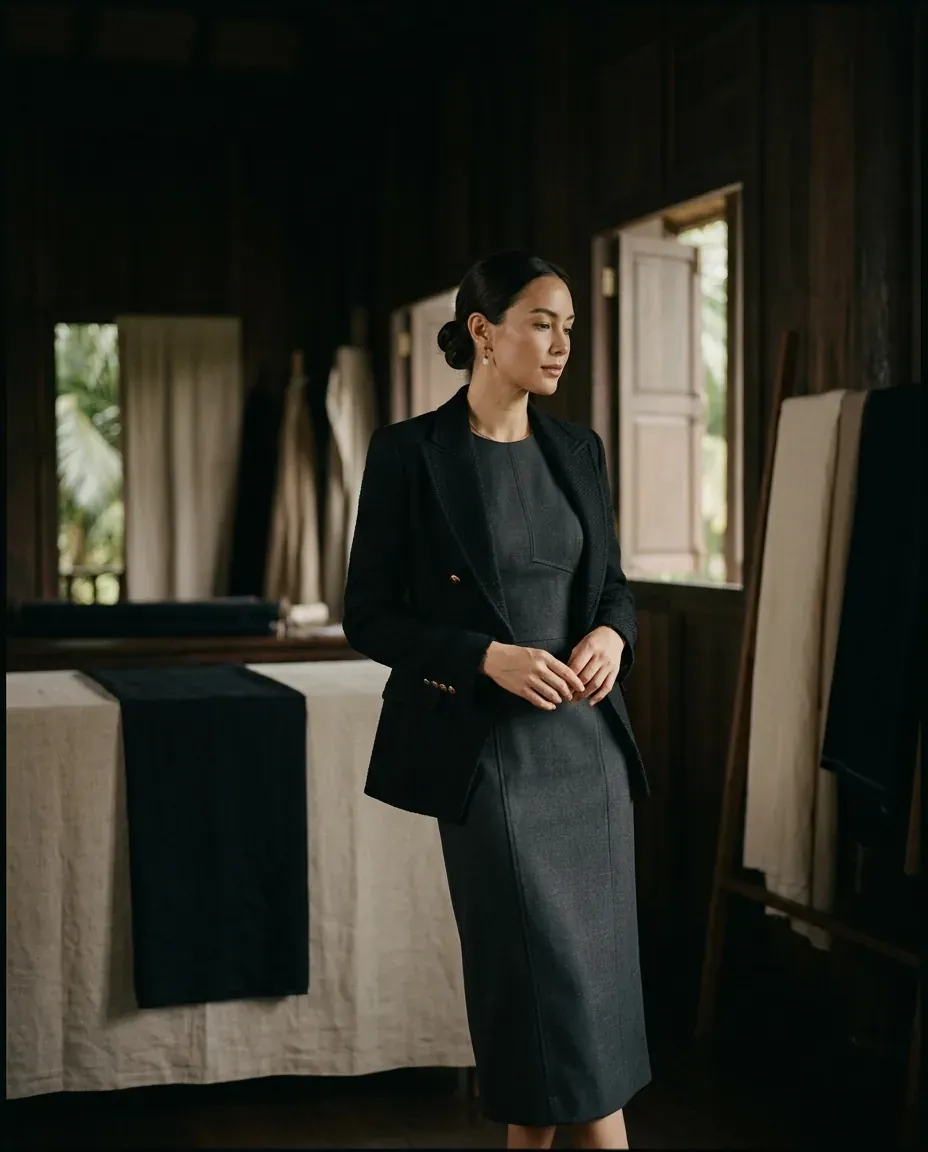
Off-the-peg womenswear fails because one size number is being asked to hold three different measurements. Bust, waist and hip rarely fall in the same size on the same person, so a garment that fits one of them is compromising on the other two. That is arithmetic rather than bad luck, and it is the whole reason a garment cut to your own measurements behaves differently — the distinction between the routes is set out in bespoke, made-to-measure and off the rack.
Why one size never fits in three places
A standard size is built on an assumed relationship between bust, waist and hip. Pick any size chart and the three measurements move together in fixed steps, which means the chart is describing one set of proportions scaled up and down rather than a range of real bodies.
Most people do not sit on that line. A common pattern is a bust two sizes above the waist, or a hip a size above the bust, and neither is unusual enough to be worth remarking on — it is simply what bodies do. But a garment cut on the standard relationship can only fit the measurement it was chosen for. Buy for the bust and the waist is loose; buy for the waist and nothing fastens.
Two more things the chart cannot hold: torso length, which decides where a waistline lands and is entirely independent of any circumference, and shoulder slope, which decides how a jacket or a fitted dress hangs from the top down. Two people with identical bust, waist and hip measurements can need visibly different garments because of those two alone.
None of that is a fitting problem to be solved with alterations after the fact. It is a pattern problem, and it is solved where the pattern is drawn.
The measurements that decide it
These are the ones that matter most for womenswear, several of which do not appear on any size chart.
- Bust, taken at the fullest point, with the tape level and a normal bra on. This measurement changes by several centimetres depending on what you are wearing under it, which is why the underwear you bring to a fitting matters.
- Underbust, separately. The gap between bust and underbust is what decides how a bodice or a jacket front has to be shaped, and it is invisible on a size chart.
- Natural waist, at the narrowest part of the torso — not where a trouser sits.
- Hip, at the widest point, feet together.
- High hip, measured below the waist rather than at it. This is where trousers and pencil skirts actually fail, and it is measured separately for that reason.
- Nape to waist, down the back. Torso length, and the reason two people at the same size need waistlines in different places.
- Shoulder slope, each side separately. Almost never symmetrical.
- Across back and across front, taken separately. They differ, and the difference decides how much room there is to reach forward.
- Arm length and bicep, for anything with a set sleeve.
- Finished length, decided against the shoes you will wear rather than in bare feet.
What is worth having made
Jackets, trousers, suits, occasion wear and a copy of something that already fits. Not everything is worth commissioning, and the honest list is shorter than a shop would give you.
- A jacket or blazer. The strongest case of all. Shoulders and bust shaping are exactly what off-the-peg gets wrong and alterations cannot fix.
- Trousers. The waist-to-hip relationship is the commonest sizing failure, and a trouser cut to it is a completely different garment.
- A suit. The same argument twice, and the reason a woman who wants a suit that actually fits usually ends up here eventually. That is what women’s bespoke tailoring is for.
- Occasion and event wear. Worn few times, photographed heavily, and usually needed in a specific colour or cloth that is not in any shop when you need it.
- A copy of something you already own and love, in a different cloth. One of the most reliably satisfying things to commission, because the fit is already proven.
- A dress for a climate you are not used to. Cloth chosen for 32°C rather than for a temperate summer.
What is usually not worth it: anything you would wear a handful of times where fit does not much matter, and anything that is nearly right already. For the second case, alterations to a garment you already own is the better answer and a fraction of the price.
What a first fitting involves
The garment is tried on deliberately incomplete, so the waist, the bust shaping and the shoulder line can still be moved. Expect it to look unfinished, and expect one more fitting than menswear usually needs. Womenswear carries more shaping — darts, princess seams, a waistline that has to land in exactly the right place — and each of those is a decision that is easier to make on your body than on paper.
At the first fitting the garment will often be tacked together with contrasting thread, edges raw, one sleeve on and one off. What is being checked is where the waist actually sits on you, whether the bust shaping is in the right place and the right amount, how the shoulder line falls, and how the garment moves when you do. You will be asked to sit down, raise your arms, and walk a few steps, because a fitted garment that is correct standing still can be unwearable in use.
This is the appointment to be honest at. Everything is still changeable and nothing costs anything to change yet. Saying a neckline is lower than you are comfortable with, or that a waist feels high, is far easier now than after the garment is finished.
What to bring
Six things, and the first two change the fit that gets marked.
- The shoes you will wear with it. Hem length is marked against a specific heel height and cannot be finalised without one.
- The underwear you will wear with it. For anything fitted through the bust this changes the fit more than any other single variable, and a different bra can move the measurement by several centimetres.
- A garment that already fits you well. Worth more than any description. It is far quicker to point at what works than to explain it.
- A garment that fits badly, if you know why. What annoys you about it is more useful information to a cutter than most measurements are.
- A picture of what you have in mind, if you have one. Ambiguity about shape is where disappointment starts.
- An idea of where and when you will wear it, which decides cloth weight and lining as much as style does.
Prices for each garment type are published rather than quoted on sight — what a garment costs here has the current starting figures, and the exact quote is confirmed before anything is cut. The workshop is in Bangtao, on the north-west coast of Phuket.