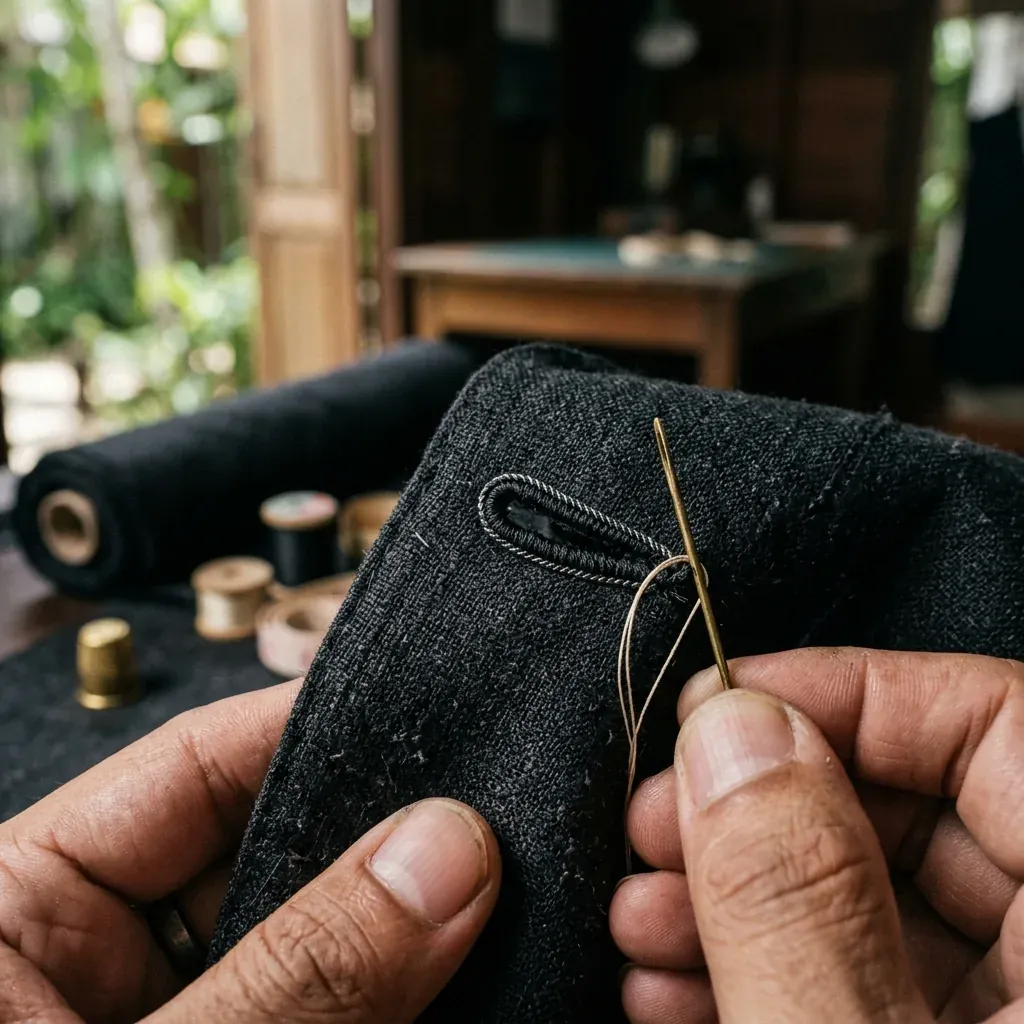
A garment can only be altered on a seam, and only by as much cloth as is folded inside that seam. Everything a tailor can and cannot do follows from that one fact: waists, hems and jacket bodies move easily because they sit on generous seams, and shoulders barely move at all because the shoulder line is structure rather than seam.
The rule that decides everything
A garment alters on a seam, and only by the cloth folded inside that seam. Alterations are not sculpture: a tailor cannot add cloth that is not there, and cannot move a line the garment is built around. What can be changed is the position of an existing seam, and the distance it can move is set by the seam allowance — the strip of spare cloth folded inside and stitched down when the garment was made.
So the useful question about any garment is not “can this be fixed” but “which seam would this run along, and how much is folded into it”. Taking a jacket waist in runs along the side seams and the back seam, all of which have allowance. Making a jacket narrower across the shoulders does not run along a seam at all; it means detaching the sleeves, recutting the shoulder and setting them back in, which is most of building a jacket.
That rule also explains why a garment cut for you needs none of this. Bespoke, made-to-measure and off the rack differ mainly in how much correcting is left to the alterations bench afterwards.
The jacket, part by part
Ten parts, and they divide cleanly: everything below and inside the shoulder moves, and the shoulder itself does not.
| Part | Can it change? | How far | Notes |
|---|---|---|---|
| Waist / body width | Yes, easily | Usually 3–5 cm total | The commonest alteration; runs on side and back seams |
| Jacket length | Yes | A few cm shorter | Shortening moves the pockets’ visual balance; lengthening is limited to the hem allowance |
| Sleeve length at cuff | Yes | 3–4 cm either way | Easy unless there are working buttonholes |
| Sleeve length at shoulder | Yes, but | Similar range | More work; done when the cuff has buttonholes or the sleeve head needs rebalancing |
| Sleeve width | Yes | Modest | Taper below the elbow is straightforward |
| Collar sitting away from the neck | Usually | — | Often a balance fault, correctable at the collar seam |
| Shoulder width | Rarely worth it | — | Structural. Near the cost of a new jacket |
| Chest width | Barely | — | Little allowance, and the canvas is shaped to the original |
| Lapel width or shape | No, in practice | — | The lapel is part of the front panel and the canvas beneath it |
| Two buttons to three | No | — | The buttonhole positions and the canvas roll are already set |
The pattern in that table is the rule restated: everything below and inside the shoulder moves, and the shoulder does not.
The trousers, part by part
Seven parts, and trousers are the more forgiving garment of the two — the waist and the hem take almost any change asked of them.
| Part | Can it change? | How far | Notes |
|---|---|---|---|
| Waist | Yes, easily | Usually 4–5 cm total | The back seam carries the most allowance in the garment |
| Hem length | Yes | Freely shorter; limited longer | Set against the shoes you will actually wear |
| Leg taper | Yes | Freely narrower | Widening is limited to the inseam allowance |
| Seat | Yes | Moderate | Runs with the waist alteration |
| Rise | Barely | — | Lowering is possible in a small way; raising is not |
| Pleats to flat front | No, in practice | — | The front panel is cut differently from the outset |
| Cuffs on or off | Usually | — | Adding cuffs requires enough length to fold |
Hemming is the one alteration almost every garment accepts, which is why it is the cheapest and the most commonly asked for, on trousers, jeans and skirts alike.
How much cloth is actually in there
Seam allowance is finite, it varies by maker, and it is the number that decides your answer. As a general guide rather than a guarantee: a trouser waist commonly has enough in the back seam to let out around 4 to 5 cm in total; a jacket body typically gives 3 to 5 cm across the side and back seams combined; a sleeve usually has 3 to 4 cm at the cuff. Better garments tend to carry more, because the maker expected the garment to be altered over its life. Very cheap garments often carry almost none, and fused construction can make what allowance exists unusable.
You can check before you go. Turn the garment inside out and look at the vertical seams — the width of cloth beyond the stitching is what you have to work with, doubled, since both sides fold in. If it is a thin strip that has been trimmed and overlocked, the answer to “can this be let out” is probably no regardless of who you ask.
How to measure for a suit sets out the numbers to take when you are working out whether a garment is close enough to be worth altering at all, so you can compare what you own against what you need.
When it is not worth doing
Six cases, and in each one the money is better spent elsewhere.
- The shoulders do not fit. This is the one that ends the conversation. A jacket too wide or too narrow at the shoulder is the wrong jacket, however good the rest looks.
- The garment is fused and already bubbling. The damage is the adhesive rather than the cloth, and no alteration repairs it.
- The cloth is worn at the seat, knee or elbow. Altering a garment that is failing elsewhere spends money on the wrong problem.
- Three or more major alterations are needed. The cost stacks quickly, and at some point the total approaches the cost of something cut for you.
- The cloth is very light or loosely woven. Old stitch lines show permanently when a seam is moved on delicate cloth.
- You do not actually like it. Fit is fixable; the wrong colour, weight or cut is not.
Where an alteration is worth doing, it is usually far cheaper than replacing the garment — here in Phuket especially. What we do and what we decline is set out under alterations to a garment you already own, and the published figures are on what a garment costs here.