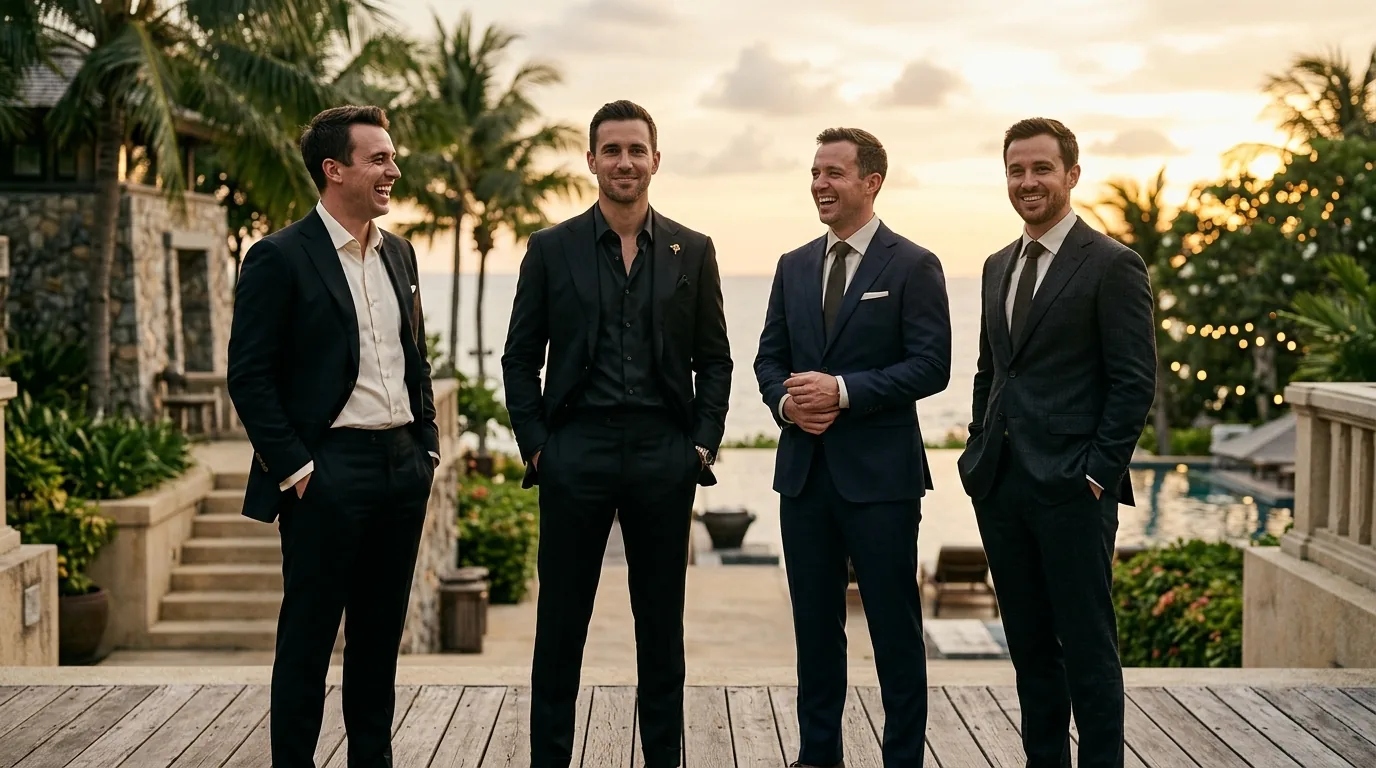
For a Phuket beach wedding, guests wear light natural cloth in mid tones: linen or an open-weave suit for men, often without a tie and sometimes without a jacket, and a midi or maxi dress in a breathable fabric for women. Avoid black and avoid white. Whatever the invitation says, assume 32°C, high humidity and sand underfoot, because those three things decide more than the dress code does.
What the invitation is actually asking for
Seven phrases cover almost every destination invitation, and the table below translates each into an outfit. They mean little on their own. This is roughly what each one asks for at a tropical beach ceremony.
| The invitation says | Men | Women |
|---|---|---|
| Beach formal | Linen or light wool suit, no tie, open collar. Jacket optional once seated | Midi or maxi dress, breathable cloth, flat or block heel |
| Beach casual | Linen trousers or smart chinos, linen shirt, no jacket | Sundress or elegant separates, sandals |
| Semi-formal / cocktail | Light suit, tie optional, leather shoes | Cocktail dress, knee to midi length |
| Formal / black tie | Rare on a beach. Usually a light dinner jacket, or a dark lightweight suit | Full-length or elegant midi |
| ”Beach glam” | Not a real dress code. Read it as beach formal with better shoes | Beach formal with more jewellery |
| ”Wear what you like” | Beach casual, and check what the couple’s families are wearing | Beach casual, erring dressier |
| Temple ceremony included | Shoulders and knees covered, shoes easily removed | Shoulders and knees covered, shoes easily removed |
The last row overrides all the others. If any part of the day happens at a temple, cover and removable shoes are not negotiable regardless of what the rest of the invitation says.
For men
A light suit in a mid tone, an open collar, and shoes that work on sand. Seven decisions, in order of how much they matter.
- A linen or open-weave suit in a mid tone. Stone, sand, light grey, soft blue. It photographs well in bright sun, where dark cloth turns into a silhouette.
- Skip the tie unless the couple asked for one. An open collar is standard at a beach ceremony and looks deliberate rather than underdressed.
- Ask for the jacket unlined or half-lined. It is the single biggest comfort difference available and costs almost nothing.
- Shoes that work on sand. Leather soles and any heel will sink and be ruined. Espadrilles, loafers, or good sandals if the invitation allows it.
- A second shirt. If the ceremony and reception are hours apart you will want it, and nobody will know.
- Trousers slightly looser than you would wear at home. The air gap is what cools you; a slim trouser in 32°C is warmer than it looks.
- A linen shirt on its own is often enough for beach casual, and it is a genuinely useful thing to own afterwards — which is what casual clothes made to measure covers.
For women
A midi or maxi in a breathable natural cloth, in a mid tone, with shoes that will cross sand. Seven decisions, in order.
- A midi or maxi in a natural cloth. Linen, cotton, silk or a light viscose. Loose beats fitted in humidity by a wide margin.
- Mid tones and prints over black. Bright sun flattens dark colours in photographs and holds heat.
- Block heels, wedges or flats. A stiletto and sand are incompatible, and most beach venues warn guests about it after the fact rather than before.
- A light wrap or jacket. Reception rooms are air-conditioned hard, and the temperature difference from the beach is substantial.
- Consider the walk. Many ceremonies involve crossing sand or grass in the outfit you were photographed arriving in.
- Something you can sit down in for four hours. A dress that is perfect standing and impossible seated is a long evening.
- A dress cut to your measurements, in cloth chosen for this climate, is the better answer when nothing you own works and the alternative is a compromise bought at home — women’s bespoke tailoring covers what that involves.
Colours to avoid, and why
Two colours are worth avoiding, and for different reasons.
Black. At many Thai gatherings black reads as funereal, and a wedding is the occasion where that association is least welcome. It is a convention rather than a rule, and you will see it broken, but it is easy to sidestep and there is no upside to testing it. There is also a purely practical argument: black absorbs heat and, in direct sun at 32°C, the difference against a pale cloth is something you feel within minutes rather than something theoretical.
White, and anything close to it — ivory, cream, pale champagne. That is the Western convention about not competing with the bride, and destination weddings are usually Western ceremonies held in Thailand, so it applies. If the couple has specifically asked for white, that instruction beats this paragraph.
Beyond those two, mid tones and prints are safe. If you want a rule of thumb: choose something you would be happy to be photographed in against bright sand, which rules out both extremes on its own.
What survives 32°C and a beach
An open-weave wool survives best, linen survives well and creases, and anything with polyester in it does not survive at all. Weight and weave matter more than the fibre on the label. A cloth you can see light through will let air reach your skin; a dense cloth at the same weight will not, and that difference is what you feel at the third hour of a reception.
Linen breathes best and creases immediately and permanently, which at a beach wedding reads as appropriate rather than untidy — it is one of the few occasions where linen’s main flaw stops being a flaw. An open-weave or high-twist wool breathes almost as well, creases far less, and is the better choice if the same garment has to work at a dinner afterwards. Cotton sits between them. Anything with polyester in it will hold heat against you no matter how light it feels in the shop. The full comparison, including what each one costs you rather than what it gives you, is in which cloth handles the heat.
Having something made while you are here
Most guests arrive several days before the wedding, and that is enough time to have something made properly rather than bought badly. It is the option none of the travel guides mentions, and for a garment you specifically cannot find at home — a linen suit in a colour that is not navy, a dress in a cloth that suits the heat — it is usually both better and cheaper than the compromise you would otherwise wear.
The practical version: come in during your first days rather than your last, and leave a clear day before the ceremony so nothing is being finished on the morning of it. We are in Bangtao, and if you are staying in Cherngtalay, Laguna or Surin the fitting can come to you. If you are in the wedding party rather than a guest, that is a different conversation with a longer timeline — wedding suits for grooms and groomsmen covers it.